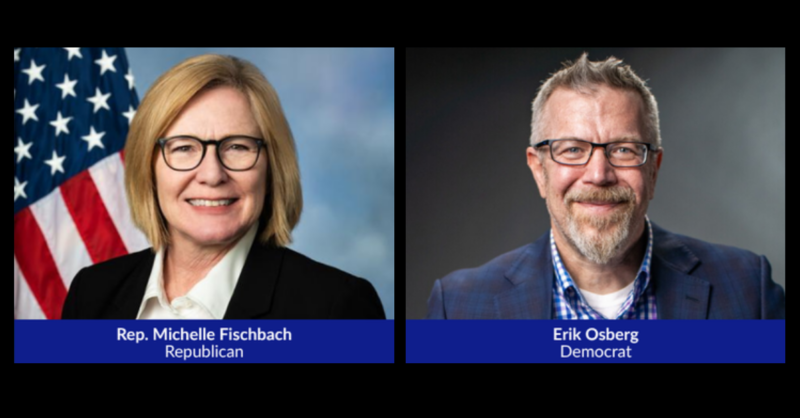
Republican U.S. Rep. Michelle Fischbach and Democratic challenger Erik Osberg offered contrasting views on agriculture, healthcare, immigration, foreign policy and federal spending during a debate for Minnesota’s Seventh Congressional District.
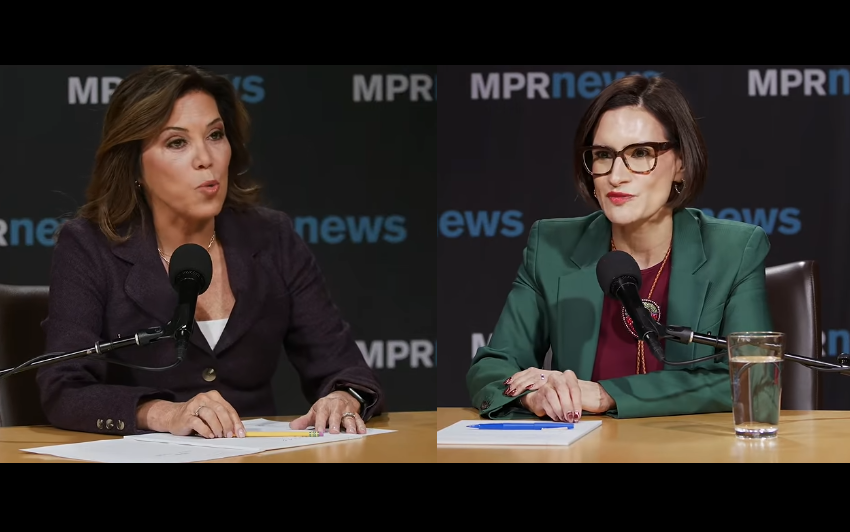
The debate, moderated by Dave Thompson and presented by Prairie Public, covered a range of issues facing voters ahead of the November 3 election. Fischbach emphasized her record in Congress and efforts to advance rural Minnesota priorities, while Osberg called for greater congressional oversight of the executive branch and changes to federal policies.
Osberg said he entered the race because “I believe that we can do better.” He pointed to his campaign’s visits to all 38 counties in the district, saying he had traveled more than 49,000 miles and held more than 300 events.
Fischbach said she has worked to represent rural Minnesota and build relationships with community leaders, agricultural organizations and other groups throughout the district.
Agriculture and Farm Profitability
Both candidates supported year-round sales of E15 ethanol blends and country-of-origin labeling for meat products, provisions included in the Senate’s version of the farm bill.
Fischbach said the House had passed its version of the legislation and that she had worked to advance E15 separately. She also highlighted legislation included in both versions of the farm bill that would increase access to capital in rural communities.
Addressing farm profitability, Fischbach pointed to high input costs and the need to develop domestic markets for agricultural products. She discussed efforts to expand domestic fertilizer production and legislation offering incentives for bio-based materials.
Osberg focused on uncertainty surrounding federal trade policy, particularly tariffs.
“The number one policy is ending the chaos and uncertainty,” Osberg said, arguing that Congress should restore its authority over tariffs. He said farmers he had spoken with were concerned about unpredictable policy decisions affecting their businesses.
Fischbach acknowledged the challenges facing farmers and said the country needs fair trade practices, particularly when competing against countries that subsidize agricultural products.
On broader manufacturing policy, Fischbach highlighted tax incentives and programs intended to encourage domestic production. Osberg said workforce development should be a priority, including investments in technical and two-year college programs to prepare workers for manufacturing jobs.
Affordability, Tariffs and Federal Spending
The candidates disagreed on how Congress should address rising costs for families.
Fischbach said affordability has no single solution, citing inflation, energy prices, regulation, taxes and workforce shortages. She argued that tax relief for working families and economic growth should be part of the response.
“We can’t afford to burden families with more taxes,” Fischbach said.
Osberg argued that Congress needs to reassert its constitutional authority over federal spending and military action, saying decisions made by the executive branch have contributed to economic uncertainty.
He also criticized the administration’s tariff policies, saying they can affect prices at grocery stores and gas stations. Osberg said tariffs should not be imposed through arbitrary decisions by a single person or a small group of officials.
Fischbach said tariffs can be useful in trade negotiations and in addressing unfair competition, although she acknowledged concerns about some of the policies. She said Congress and the administration had worked to address certain tariffs.
On the national debt, Osberg said the country faces roughly $40 trillion in debt and argued that spending reductions alone would not solve the problem.
“We have to look at both sides of the balance sheet,” he said, calling for targeted spending cuts alongside changes to how the government collects revenue.
Fischbach pointed to Republican efforts to identify wasteful spending, review federal agencies and pass appropriations bills. She said the government needs to reduce spending and examine programs regularly rather than allowing them to continue indefinitely without review.
The candidates also offered different approaches to balancing the federal budget. Fischbach called for reviewing government departments and expenditures, while Osberg said Congress should end unnecessary spending on wars and what he described as vanity projects while closing corporate tax loopholes.
Healthcare in Rural Minnesota
Keeping critical access hospitals and other rural healthcare providers operating was another point of disagreement.
Fischbach highlighted federal funding through a rural healthcare transformation program, along with telehealth services that can help hospitals, emergency medical services and patients in areas with limited access to specialists.
She also called for preserving the 340B drug pricing program used by many small hospitals and reducing regulations affecting nursing homes.
Osberg said he would seek to restore Affordable Care Act subsidies, Medicare Part D provisions, Medicaid eligibility and federal funding for healthcare and medical research.
He said rural healthcare executives had expressed concerns about the effects of recent federal legislation.
Osberg also described conditions facing nursing homes as a “sledgehammer effect,” saying providers were experiencing significant pressure under current policies.
Fischbach disputed Osberg’s characterization of the Affordable Care Act subsidies, saying the subsidies at issue were temporary COVID-era provisions that expired under legislation passed during the Biden administration.
Social Security and Medicare
Both candidates agreed that Social Security faces a long-term funding challenge, with the program projected to face a shortfall in the coming years if changes are not made.
Osberg proposed eliminating the cap on earnings subject to Social Security payroll taxes. Under his proposal, higher-income earners would contribute taxes on more of their income, helping sustain the program and potentially allowing benefits to expand.
He also said he would oppose privatizing Social Security.
Fischbach said Congress needs to consider several options while protecting current beneficiaries from benefit cuts. She said lawmakers are examining possible changes involving investments, retirement ages and other aspects of the program.
She acknowledged that removing the payroll tax cap is among the options being considered but said a combination of measures would likely be necessary.
Osberg argued that Congress needs to act quickly rather than continue studying potential changes.
Immigration and Workforce Needs
Fischbach said border security had improved and that the next priority should be reforming legal immigration programs, particularly agricultural worker visas.
She said she has worked with agricultural leaders on legislation to reform the visa system and help farmers obtain the workers they need.
Osberg said he supports border security but disputed the claim that the border issue has been fully resolved. He called for a clearer path to citizenship for eligible immigrants and additional resources to address processing backlogs.
“We don’t need open borders, but we need to figure out a clear and concise earned path to citizenship,” Osberg said.
He also described immigration as both a workforce and humanitarian issue.
Military Action and Foreign Policy
The candidates offered differing views on U.S. military involvement in Iran and support for Ukraine and Israel.
Fischbach said Congress should exercise oversight over military action but argued that preventing Iran from obtaining nuclear weapons is a priority.
She opposed calls for an immediate withdrawal of U.S. forces, warning that a rapid departure could endanger American troops and would not necessarily reduce energy prices.
Osberg said Congress should reclaim its constitutional authority over decisions to go to war. He argued that diplomatic agreements, sanctions and inspections had been in place before the military action against Iran.
“We got to figure out a way out of these forever wars,” Osberg said.
On Ukraine, Osberg said the United States should stand with its allies against Russian aggression. Fischbach said the country needs transparency and accountability regarding aid to Ukraine, while also emphasizing support for Israel.
Osberg agreed that Israel can be an ally but said the United States should not automatically support every action taken by the Israeli government.
Data Centers, Artificial Intelligence and Technology
The candidates also disagreed over the role of federal regulation in the development of data centers and artificial intelligence.
Osberg called for strict regulations on data centers, citing concerns about environmental impacts and the ability of large companies to operate in rural communities with limited administrative resources.
He also raised concerns about potential security risks associated with artificial intelligence.
“I believe in authentic intelligence more than I believe in artificial intelligence,” Osberg said.
Fischbach said artificial intelligence needs safeguards to protect the public but cautioned against regulations that could quickly become outdated as technology changes.
She argued that decisions about whether to permit data centers should largely be made by local governments, which can negotiate with developers based on community needs.
Fischbach also cited federal legislation requiring data center operators to pay for necessary electrical grid upgrades. Osberg agreed that local solutions are important but said rural communities may need stronger protections when dealing with large corporations.
Election Security and Presidential Authority
The candidates disagreed over election security and how Congress should respond when a president exceeds constitutional authority.
Osberg said states should continue to administer elections and that Congress should focus on ensuring eligible citizens can vote. He criticized efforts he believes undermine public confidence in election results, including Fischbach’s vote against certifying electoral votes from Arizona and Pennsylvania following the 2020 presidential election.
Fischbach said her position was intended to allow investigations into concerns about those states’ election results. She also expressed support for the SAVE Act, which would require voter identification and limit voting to U.S. citizens.
Osberg responded that indictments related to alleged illegal voting do not establish guilt and said election security should be evaluated using evidence.
On presidential authority, Osberg said members of Congress have an obligation to follow the Constitution regardless of which party controls the White House.
“Congress takes an oath to the Constitution, not a president, not a party,” he said.
Fischbach said Congress should address serious abuses of presidential authority through legislation or resolutions, while noting that disputes have also been handled through the courts.
Education and Student Loans
Both candidates supported changes to the federal student loan system and encouraged greater use of two-year colleges and technical programs.
Osberg proposed capping federal student loan interest rates at 5%, saying high borrowing costs can place significant pressure on graduates. He shared that he had refinanced his home to pay off his own student loans.
Fischbach said the student loan system needs reform but argued that simply paying off loans is not the answer. She encouraged students to consider two-year colleges, including programs that allow credits to transfer toward a four-year degree.
Gun Rights and Party Independence
Both candidates said they support the Second Amendment, although they differed in their approach to gun regulation.
Fischbach, who said she is endorsed by the National Rifle Association, opposed additional federal gun regulations, saying she did not see any current proposals she could support.
Osberg said he is a gun owner and does not currently have specific federal gun law changes he would pursue. However, he called for broader discussions about violence and public safety.
On disagreements with their respective parties, Fischbach cited her work to advance year-round E15 legislation despite opposition from some Republican leaders. Osberg said he could break with Democratic Party positions on firearms and would vote against his party whenever he believed doing so was in the district’s best interests.
Constituent Access and Accountability
Both candidates highlighted their outreach efforts across the district.
Fischbach said she and her staff had conducted more than 170 visits with businesses, hospitals and community groups over 18 months. She also cited telephone town halls that she said had reached more than 50,000 people, along with mobile office hours for constituents seeking assistance.
Osberg said his campaign had held more than 330 events, including 30 fish fry town halls. He said the events are open to the public regardless of political affiliation and allow attendees to ask questions directly.
If elected, Osberg said he would build a congressional staff focused on constituent service and measure his performance through accessibility and responsiveness.
Fischbach said she would continue building relationships across the district and working on issues affecting rural communities, while noting that specific legislative outcomes depend on the issues Congress faces.
Closing Statements
In his closing remarks, Osberg thanked supporters who had joined his campaign over the previous 19 months and said he believed the race was competitive.
Fischbach emphasized her experience representing the district, her relationships with community leaders and her work on agriculture, tax relief, healthcare and infrastructure.
She asked voters to return her to Congress for another term.
The debate was moderated by Dave Thompson and presented by Prairie Public as part of its 2026 election coverage. Election Day is November 3.