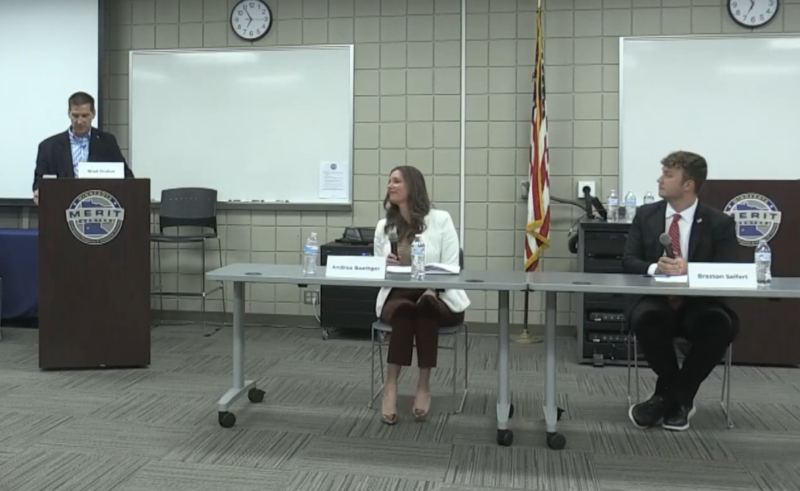
Screenshot from Studio 1 Broadcast. Marshall Area Chamber of Commerce President Brad Gruhot, DFL candidate Andrea Boettger, and Republican candidate Braxton Seifert.
MARSHALL, Minn. – Minnesota Senate District 15 candidates Andrea Boettger, a DFLer, and Republican Braxton Seifert discussed taxes, government fraud, childcare and rural services during a candidate forum Wednesday at the MERIT Center in Marshall.
The candidates offered differing approaches to the state’s tax climate, with Seifert calling for lower taxes and fees while Boettger emphasized responsible spending and reviewing existing programs.
Seifert said Minnesota consistently ranks among the top states for property, income and sales taxes. He argued that government fraud and excessive regulations are contributing to higher costs for residents and businesses.
“We should not be raising taxes, and I’ll do one better, we should not be raising fees,” Seifert said.
Boettger, who serves as New Ulm City Council president, said state government needs to review programs and find ways to use existing funding more effectively. She cautioned against promising there would be no tax increases under any circumstances.
“I wouldn’t say that we’re not gonna raise taxes, but I think, say that we need to do our jobs and be responsible with the tax dollars that we have,” Boettger said.
On government fraud, Seifert called for mandatory annual audits, reviewing programs from the beginning of each budget cycle and conducting unannounced visits to verify services are being provided. He also called for greater accountability among state officials.
Boettger said Minnesota needs better technology to help workers identify fraud, along with independent oversight and stronger accountability for legislators and others responsible for administering programs.
“People should be fired if they weren’t doing their jobs,” Boettger said, while adding that fraud prevention also needs to address larger corporations and third-party payments.
The candidates agreed Minnesota’s Paid Family and Medical Leave program needs changes, although they emphasized different concerns.
Seifert supported reducing the number of weeks available, narrowing the definition of eligible family members and allowing exemptions based on business size or industry. He said the program adds costs for employers and local governments.
Boettger also supported clarifying eligibility requirements and considering exemptions for nonprofits. She said the program provides important support to families but needs to be easier for employers to administer.
She cited a local example of a woman who said paid leave helped her through postpartum depression.
“There are real stories of people that it helps, but we got to make it a little bit more straightforward on how that works and to not incentivize long-term leave from work,” Boettger said.
On childcare, both candidates supported reviewing regulations to increase availability and reduce costs.
Seifert said Minnesota should consider allowing licensed providers to care for additional children when they have sufficient staff and capacity. He pointed to South Dakota’s childcare costs as an example of how neighboring states approach the issue.
Boettger discussed New Ulm’s use of a pod-model daycare and said communities should explore ways to expand childcare facilities. She also called for more flexible training requirements for experienced providers.
Agriculture was another major topic, with both candidates emphasizing the importance of supporting farmers and keeping rural communities economically strong.
Seifert said the state should fully fund programs supporting beginning farmers, expand agricultural markets and reduce regulations that slow farm operations. He also called for faster permitting processes and said farmers should be able to pass their operations to the next generation.
“Our farmers want to get paid in the marketplace, not the mailbox,” Seifert said.
Boettger highlighted farm transitions, affordable healthcare and access to mental health services for farmers. She also stressed the importance of protecting farmers’ right to repair their equipment.
Both candidates said rural communities need reliable access to healthcare and emergency medical services.
Boettger said rural EMS services are struggling to recruit volunteers and that training requirements can make it difficult for people to participate. She called for changes that would help recruit and retain emergency responders while supporting rural hospitals.
Seifert said the state should continue supporting rural EMS programs and ensure local hospitals remain available to receive patients. He also advocated for market-based healthcare reforms to increase competition and reduce insurance costs.
The candidates also addressed school funding and the future of regional higher education institutions.
Seifert called for reducing state mandates on schools and giving local districts more authority over classroom decisions. He said communities should have greater control over how they address their students’ needs.
“We need to let our teachers teach,” Seifert said.
Boettger said schools need adequate resources to educate students and support local economies. She also backed changes to Minnesota’s permanent school fund to improve how money is distributed to schools.
Both candidates expressed support for keeping regional college campuses open and helping students remain in Southwest Minnesota after graduation.
Seifert said he would not vote to close a college campus in rural Minnesota, calling the institutions important to local economies and communities.
Boettger said Minnesota needs stronger incentives to attract students to regional colleges and encourage graduates to live and work in the state. She pointed to South Dakota as an example of a state offering incentives that can attract students.
In closing, Seifert said his priority would be restoring economic opportunity so residents can start businesses, raise families and afford housing and healthcare in rural Minnesota.
Boettger said she would focus on childcare, healthcare, school support and infrastructure, including water treatment facilities and lead pipe replacement.