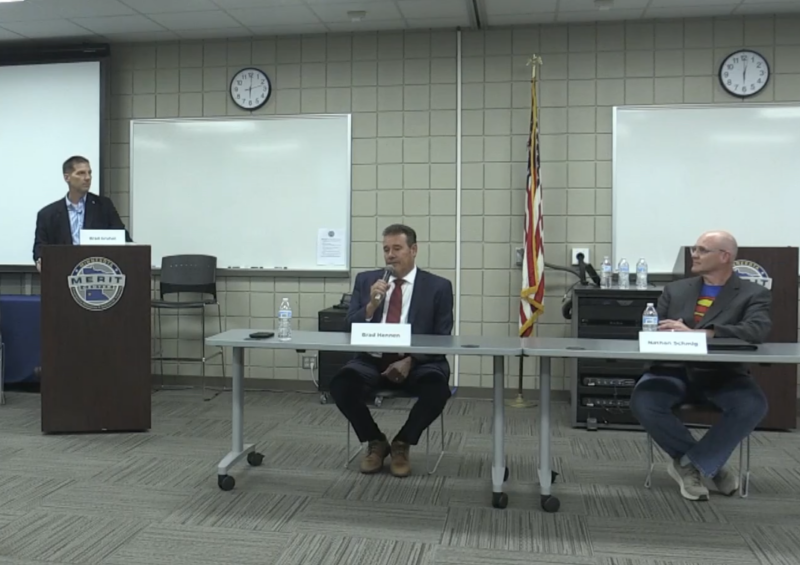
MARSHALL, Minn. — Minnesota House District 15A candidates Nathan Schmig (DFL) and Brad Hennen (Republican) discussed taxes, health care, child care, education and government spending during a candidate forum Tuesday.
The forum featured questions from Marshall Independent editor Mike Lamb and community members.
The candidates differed on taxes, with Hennen arguing Minnesota has a spending problem rather than a revenue problem. He said state government should focus on using existing tax dollars more effectively.
“I don’t believe that there’s anybody in Minnesota who’s currently undertaxed,” Hennen said.
Schmig said taxes should remain as low as possible but would not rule out increases if needed to maintain essential services, including special education, emergency medical services and rural health care.
“I would not rule out any possible tax increase if it becomes necessary,” Schmig said.
The candidates also disagreed on Minnesota’s paid family and medical leave program. Schmig said he was reluctant to support cuts without more information, citing the importance of leave for families while acknowledging the program’s effects on small businesses.
Hennen said the program’s impact on small businesses needs to be addressed, including the possibility of allowing businesses to opt out. He argued employers and workers should have more flexibility in determining benefits.
Health care access was another major topic. Schmig warned that federal funding cuts could put additional pressure on rural hospitals and emergency medical services, potentially forcing residents to travel farther for care.
“We’re gonna be in serious trouble here,” Schmig said, referring to anticipated effects of federal cuts.
Hennen argued that excessive regulation limits the supply of health care providers and drives up costs. He said lawmakers should make it easier to build and maintain hospitals and allow medical professionals to take on responsibilities they are qualified to perform.
Both candidates addressed child care shortages. Schmig said lawmakers should review regulations affecting small child care providers and provide assistance to help them meet necessary requirements. Hennen said reducing regulatory burdens would be the most effective way to increase availability.
“The most important thing we can do with child care is not to subsidize it but to reduce the regulatory burden,” Hennen said.
On education, Hennen emphasized parental involvement, school discipline and giving families more choices in where their children attend school. He also said existing schools should receive the funding needed to support teachers and students.
“Our parents need to remain involved, that’s the biggest difference whether it’s a home school or a private school or a public school,” Hennen said.
Schmig said rural communities need access to the same essential services available in larger cities. He also highlighted the need for reliable broadband access, particularly for students who rely on internet connections during snow days and other disruptions.
The candidates offered different approaches to preventing fraud in state government. Hennen said officials should verify the financial credibility of recipients before distributing public funds rather than trying to recover money after fraud occurs.
“We need to make sure that those people have a proven track record before we send money out,” Hennen said.
Schmig said lawmakers should maintain oversight while ensuring people who qualify for assistance are not denied needed support. He said the state must remain vigilant against fraud without causing additional harm to vulnerable residents.
“Stealing funds is wrong and I can’t imagine anyone arguing in favor of fraud,” Schmig said.
On gun policy, Hennen opposed additional restrictions on gun ownership, saying lawmakers should focus on addressing mental health concerns and preventing people who pose a danger from accessing firearms. He said existing laws against violence should be enforced and that he supports finding ways to separate people experiencing mental illness from weapons when necessary.
Schmig discussed possible restrictions for people with certain histories, including domestic violence, animal abuse or mental illness. He also proposed consequences for gun owners whose weapons are used in crimes if they failed to secure them.
The candidates also discussed library funding and other public services. Schmig said the state may need to help maintain services as federal funding changes, warning that cuts could affect libraries, health care and education.
“We can’t just let them melt away to nothing at this point,” Schmig said.
Hennen said he was open to exploring different ways for libraries to deliver services, including using technology and giving libraries more flexibility. He questioned whether additional state funding would necessarily be the solution.
In discussing priorities for the district, Schmig highlighted health care, education, food security and infrastructure. He also pointed to a proposed regional facility to treat landfill leachate containing PFAS, or so-called forever chemicals, as a project he would support.
Hennen identified health care access as a central concern, along with child care and job availability. He said lawmakers should focus on increasing the supply of services to improve access and affordability.
In closing statements, Schmig emphasized affordable health care, environmental protection and government accountability. He also called for protecting the Boundary Waters from potential mining-related pollution and giving communities a say in where artificial intelligence data centers are built.
Hennen said lowering the cost of living, particularly health care costs, should be a priority. He argued that regulation can limit availability and increase prices.
“Our focus in the legislature should be on increasing the access, increasing the supply and not on further regulation,” Hennen said.
Both candidates described campaigning as an opportunity to meet residents and hear their concerns ahead of the November election.